 The S’harin – Desert Elves
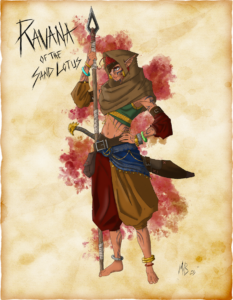
The S’harin are a proud and resilient elven people, tall and lean with sun-darkened skin and eyes like polished amber or deep obsidian. Their long limbs and wiry frames are well-suited to the vastness of the desert, allowing them to move swiftly and silently across the sands. Known as masters of survival, the S’harin have perfected the art of living off the sparse resources of the desert, relying on deep wells of knowledge, innate magic, and uncanny endurance.
Nomadic by nature, the S’harin wander the desert in tight-knit clans, fiercely guarding their secrets from outsiders. They value independence, self-sufficiency, and strength, seeing reliance on others as a weakness. They have little patience for those who intrude upon their lands, and to enter S’harin territory uninvited is to invite a swift and silent attack.
The S’harin are adept in the natural magics of the desert, drawing power from the wind, sun, and sands themselves. Using mirages, illusions, and enchantments, they are known to create entire camps hidden from view, or to blend seamlessly into the dunes to avoid detection. Some speak of seeing entire clans vanish into thin air, leaving behind nothing but wind-stirred sand. Their spiritual connection to the desert is strong, believing that the Land of Forgotten Horizons is sacred, holding memories of ancient life and spirits bound to protect it.
ELF TRAITS
Elves tend to any profession and trade that let’s them act freely.
Ability Score Increase.
Your Dexterity score increases by2, and you choose to increase your Intelligence or Charismaby 1.
Age.
Elves reach physical maturity at the same rate as humans but must pass the tribe’s rites of initiation before being recognized as adults, typically around 20. Elves can live to 140 years.
Alignment.
Elves tend chaotic because of their love of freedom, variety and self-expression. They tend neutrality, though they tend good (self-sacrifice) when the tribe is concerned. Although they will steal everything in sight, they are not murderous and avoid unnecessary violence.
Size.
A typical elf stands about 6 1/2 to 7 1/2 feet tall and around 175 pounds. Your size is Medium.
Speed.
Your base walking speed is 40 feet.
Burst of Speed.
Your heritage allows you to move in sprints. When you move on your turn in combat, you can double your speed until the end of the turn. Once you use this trait, you can’t use it again until you move 0 feet on one of your turns.
Elven Resilience.
You are conditioned to the extreme weather of the wastelands and have advantage on all saves against extreme heat and cold.
Mask of the Wild.
You can attempt to hide even when you are only lightly obscured by terrain, weather, or other natural phenomena.
Elf Run.
You add your Constitution score to the number of miles you can travel in a day. You have advantage on forced march saves.
Languages.
You can speak Common and Elvish. Each tribe has a distinct dialect. The language is filled with short, clipped words, run with a rapid staccato pace difficult for others to pick up. They disdain the slow, tedious languages of others but condescend to learn Common. Elves that learn other tongues hide it to gain advantage.
The Ura’da – The Wild Halflings of the Verdant Rise
The Ura’da are a ruthless, enigmatic and xenomorphic people, often described as wild-hearted and dangerously cunning. Dwelling in The Verdant Rise, a lush, elevated oasis hidden deep within the desert, they are one of the few societies to thrive in an environment otherwise harsh and unforgiving. While they are small in stature, the Ura’da are feared for their ferocity and their dark rituals. They fiercely protect their verdant homeland, regarding it as sacred and inviolable—a divine gift meant solely for their kind.
These halflings are known cannibals, believing that consuming the flesh of intruders and raiders grants them strength and fortitude. They paint their skin with bright pigments derived from desert plants and wear carved masks of sacred, twisted wood, shaped into grotesque visages that terrify those who encounter them. Each mask is unique, fashioned to honor the wild spirits of the land, and only the Ura’da know the rites to imbue them with protective magic.
Though they are largely isolated in The Verdant Rise, the Ura’da periodically raid the desert below, hunting both beast and outsider with unmatched fervor. They strike with little warning, moving in coordinated packs that rely on ambush tactics and an innate knowledge of their terrain. Their war chants echo across the sands as they descend, leaving those who survive these encounters haunted by tales of the masked halflings who carry their dead away to their high, green land.
Ura’da TRAITS
Ura’da traits reflect their savage nature.
Ability Score Increase.
Your Dexterity score increases by 2 and your Wisdom score by 1.
Age.
Ura’da reach adulthood at the same rate as humans and live to be about 120 years old.
Alignment.
Ura’da tend towards law and neutrality. Uncomfortable with change, Ura’da tend to rely on intangibleconstants, such as racial identity, family, clan ties and personal honor. Ura’da generally have little understanding of the morals of the big people.
Size.
Hin average around 3 ½ feet tall and 50 to 60pounds. Your size is Small.
Speed.
Your base walking speed is 30 feet.
Ura’da Nimbleness.
You can move through the space of any creature that is of larger size than yours.
Savage Attacks.
When you score a critical hit with a melee attack, you can roll one of the weapon’s damage dice one additional time and add it to the extra damage of the critical hit.
Fury of the Small.
When you damage a creature at least one size larger than you with an attack or spell, you can cause the attack to add extra damage equal to your level. Once you use this trait, you cannot use it again until you finish a short or long rest.
Languages.
You can speak Ura’da and Common. Your culture uses drawings and tales rather than a written language. Ura’da rarely teach others their language, but some individuals of the Great Desert have learned the wild speech. Ura’da found in the Great Desert learn Common to survive, but it is generally unknown past the Verdant Rise.
 The Dunmir – Half-Giants of the Desert’s Edge
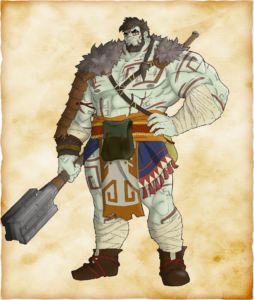
The Dunmir, whose name means “Keepers of the Sands,” are a race born from a mix of human resilience and giant strength, created in ancient times through means now lost to history. Standing well above most humans, with muscled builds and sun-scorched skin, the Dunmir have become a familiar sight along the borders of the desert. While their giant kin terrorize the sands, wading down from their mountain strongholds to raid and pillage, the Dunmir are often seen as guardians, working with human settlements to protect them from both the hazards of the desert and the menace of giants.
Though smaller than their full-blooded giant kin, the Dunmir are still incredibly strong, with powerful endurance that allows them to traverse the vast, unforgiving sands. Known for their calm yet watchful demeanor, they make excellent warriors, scouts, and stoneworkers, contributing their physical prowess and ancient knowledge to the communities that welcome them. Many have embraced roles as protectors, taking pride in defending their homelands from the same giant bloodline that haunts their past.
The Dunmir are deeply attuned to the land itself, some possessing primal magics that allow them to shape stone or draw strength from the earth. Their heritage is a source of both pride and challenge, as they often walk a fine line between their connection to the giants and their desire for peace and belonging among humans. The Dunmir, loyal and fierce, remain steadfast along the edges of the Sea of Dust, a living testament to resilience born of two worlds.
HALF GIANT TRAITS
Dunmir inherit a solid balance of their giant and human lineages.
Ability Score Increase.
You have 4 points to split between your Strength and Constitution scores. Your Strength score may reach a maximum of 22 instead of 20. Your Intelligence and Wisdom scores are decreased by 2 each.
Age.
Half Giants mature around 24 years of age and can live up to 220 years.
Alignment.
Your alignment may fluctuate as described in
Alignment on a Whim.
You begin with one fixed alignment axis (good-neutral-evil or lawful-neutral-chaotic) that will never change. The other axis may change depending on who you are emulating. Subject to DM approval, when imitating a charismatic leader, select an appropriate Ideal or Flaw and replace your current one. If the new Ideal is tied to a non-fixed axis of your alignment, change that aspect of your alignment.
Size.
A typical Dunmir stands 10 to 12 feet tall and weighs1,600 pounds. You occupy a 10-foot by 10-foot space and have a 10 foot reach. Your size is Large.
Speed.
Your base walking speed is 35 feet.
Giant Body.
You cannot wear ordinary gear sized for smaller creatures such as boots, gloves, and backpacks. All clothing, armor, meals, and lodging cost double for you.
Large Hands.
You may wield versatile and two-handed melee weapons with one hand.
Colossal Endurance.
Your immense body mass allows you to occasionally shrug off injury. When you take damage, you can use your reaction to reduce that damage by your Constitution score. After using this trait, you cannot use it again until you finish a short or long rest.
Giant’s Toughness.
Your hit point maximum increases by2 and it increases by 2 every time you gain a level.
Languages.
You can speak Common.
The Krinari
The Krinari are an ancient race of desert-dwelling insectoids, shaped by generations of survival beneath an unforgiving sun and endless seas of sand. Rather than forming a single unified culture, the Krinari exist as a collection of clans and subspecies, each adapted to a specific ecological niche within the Great Desert.
Their societies are organized around desert holds—fortified settlements carved into stone, buried beneath dunes, or built atop hardened glass plains. Each hold is fiercely independent, ruled by clan elders, war-leaders, or councils of proven strength. To outsiders, Krinari society can seem harsh and inflexible, but among themselves they prize loyalty, endurance, and purpose above all else.
Though all Krinari share a common ancestry, centuries of adaptation have created stark physical differences between subspecies. To the Krinari, these differences are not divisions, but expressions of survival.
Krinari Subspecies
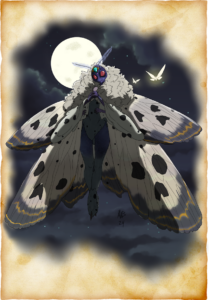 Leõmhann (Leum Han) – Moth-like Krinari The Leõmhann are Krinari with a striking, moth-like appearance, known for their gentle, wispy antennae, large expressive eyes, and intricately patterned wings that shimmer in the desert sun. Unlike their more martial cousins, the Leõmhann tend to avoid direct conflict, using their wings to traverse the desert at night and blending into the sands. They are often seen as mystics and seers within Krinari culture, revered for their deep connection to the desert’s spiritual essence.
The Leõmhann are the quiet watchers of the desert — pale-winged figures drifting through moonlit dunes like living spirits. Their bodies are slender and lightly built, covered in fine down or smooth chitin, with long, delicate antennae that constantly taste the air for magic, emotion, and change. Their wings are broad and patterned with swirling designs that resemble constellations, ancient runes, or shifting desert winds.
Among the Krinari, the Leõmhann are revered not for strength, but for perception, foresight, and restraint. They serve as mystics, night-guides, dream-speakers, and interpreters of omens. Where others see only sand and stars, the Leõmhann see meaning.
Leõmhann Traits
Age
Leõmhann mature around the age of 20 and can live up to 80 years, though many claim their elders simply “fade into the desert” rather than die.Alignment
Leõmhann tend toward neutral or good alignments. Their philosophy values balance, patience, and harmony with unseen forces. They may be lawful in tradition or chaotic in intuition, but rarely cruel.Size
Leõmhann are Medium, typically standing between 5 and 6½ feet tall, with wide wingspans that can reach up to 12 feet.Speed
Your walking speed is 25 feet. Fly Speed of 30 feet.Languages
You can speak, read, and write Common, Insect-Common, and Leõmhann Cant, a soft, tonal language filled with clicks and breathy vowels.
Base Leõmhann Features
Desert Nocturne
You have advantage on Wisdom (Perception) checks made at night or in dim light.Soft Landing
You take no damage from falling if you are conscious, as long as you have space to unfurl your wings.Antennae Sensitivity
You have advantage on saving throws against being surprised, and you gain proficiency in either Insight or Survival.Glimmer-Wings
As a bonus action, you can subtly alter the color and pattern of your wings, granting advantage on one Stealth or Performance check made in sandy, rocky, or dimly lit environments.You can use this feature a number of times equal to your proficiency bonus, regaining all uses on a long rest.
Leõmhann Subtypes
Moonveil Leõmhann
(Mystics & Seers)
Moonveil Leõmhann are pale-winged visionaries whose markings glow faintly in moonlight. Their antennae are long and feathery, constantly shifting as if listening to voices no one else can hear.
Ability Score Increase
Your Wisdom increases by 2, and your Charisma increases by 1.Desert Omens
You can cast augury once without expending a spell slot. When cast this way, the spell manifests as drifting sand, fluttering wings, or whispered dreams.You regain this ability after a long rest.
Veil of Stillness
As a reaction when you fail a saving throw, you can roll a d4 and add it to the result. Once you use this feature, you can’t use it again until you finish a short or long rest.
Dunewhisper Leõmhann
(Scouts & Night Travelers)
These Leõmhann favor darker wing patterns — browns, deep blues, and dusty golds — allowing them to vanish against the night dunes.
Ability Score Increase
Your Dexterity increases by 2, and your Wisdom increases by 1.Silent Glide
You can move up to half your flying speed without provoking opportunity attacks when you begin your turn in dim light or darkness.Sandblend
While in sandy or rocky terrain, you can attempt to Hide even when only lightly obscured.
Sunflare Leõmhann
(Lightbearers & Wardens)
Rare and striking, Sunflare Leõmhann have wings patterned in golds, oranges, and radiant whites. Their presence is associated with protection, revelation, and guiding the lost.
Ability Score Increase
Your Constitution increases by 2, and your Wisdom increases by 1.Radiant Pulse
As an action, you can cause your wings to flare with blinding light. Creatures of your choice within 10 feet must succeed on a Constitution saving throw (DC = 8 + proficiency bonus + Wisdom modifier) or be blinded until the end of your next turn.Once you use this feature, you can’t use it again until you finish a long rest.
Lightbound Resilience
You have resistance to radiant damage.
Leõmhann Culture & Beliefs
Spiritual Role
Leõmhann believe the desert remembers everything. Winds carry memory. Stars reflect fate. Dreams are messages waiting to be understood.
They serve as:
-
Dream-readers
-
Night guides
-
Ward-speakers
-
Mediators between clans
Their counsel is sought before major migrations, wars, or rites.
Rites & Traditions
The Wing Vigil
A Leõmhann spends an entire night aloft during their first solo flight, guided only by starlight.The Dust Communion
A spiritual rite where they bury their wings in warm sand and meditate until dawn, seeking visions.The Final Drift
Elders sometimes fly into the deep desert alone, following a dream or omen, never to return.
Naming Conventions
Leõmhann names are soft, flowing, and melodic, often inspired by wind, light, and memory.
Given Names:
-
Saelith
-
Miruun
-
Thaeva
-
Lioren
-
Vaelis
-
Nyxari
Titles:
-
Dreamwalker
-
Wind-Seer
-
Moonbound
-
Keeper of Quiet Stars
A formal name may be spoken as:
“Saelith Moonveil, Reader of the Third Wind.”-
-
The Dalegg — Beetle-Like Krinari. The Dalegg are the most physically imposing of the Krinari, towering insectoids whose bodies resemble massive desert beetles. Their thick chitinous shells gleam in the sun like polished stone or burnished metal, offering natural protection against predators, sandstorms, and blades alike. Within Krinari society, the Dalegg are revered as defenders, enforcers, and living bulwarks. Where other subspecies scout, trade, or adapt, the Dalegg endure. They are often placed at the forefront of warbands, guarding clan holds, caravans, and sacred sites. Despite their intimidating presence, Dalegg culture is deeply rooted in honor and conviction. They tend toward extremes—when a Dalegg commits to a cause, they do so completely. Compromise is rare; certainty is everything.
Dalegg Traits
Age
Dalegg mature slowly, reaching adulthood around 8 years of age. Their robust physiology allows them to live up to 55 years, though many fall earlier in battle or hardship.Alignment
Dalegg are creatures of intensity. They tend toward strong moral extremes, often being either deeply honorable or mercilessly cruel. Likewise, they usually embrace Law or Chaos, guided by rigid codes or personal conviction rather than moderation.Size
Dalegg are Medium, though many stand between 5 and 7 feet tall, with broad, stocky frames and heavy carapaces.Speed
Your base walking speed is 25 feet.Languages
You can speak, read, and write Common, Insect-Common, and Beetle.Natural Armor
Your thick chitin provides natural protection. While not wearing armor, your AC equals 13 + your Dexterity modifier.
(Some Dalegg variants improve upon this.)
All Dalegg receive the Toughness Feat for Free
Dalegg Subtypes
Though all Dalegg share common ancestry, different beetle lineages have produced distinct physical and cultural traits.
Rhinoceros Beetle Dalegg
Massive and towering, Rhinoceros Dalegg are the largest of their kind, often standing over 7 feet tall. Their forward-jutting horn and immense strength make them devastating shock troops. They are proud, boisterous, and known for loud feasts, competitive drinking, and ritual boasting.
Ability Score Increase
Your Strength score increases by 2, and your Constitution score increases by 1.
Powerful Build
You count as one size larger when determining your carrying capacity and the weight you can push, drag, or lift.
Goring Rush
As a bonus action, you can move up to your speed toward a creature you can see and make one melee weapon attack with your horn.
-
This attack uses Strength
-
On a hit, it deals 1d6 + Strength modifier piercing damage
You can use this feature a number of times equal to your proficiency bonus, regaining all uses on a long rest.
Stag Beetle Dalegg
Broad-shouldered and heavily armored, Stag Dalegg are known for their immense durability and calm demeanor. Their thick, layered carapaces make them living fortresses. Among the Dalegg, they are the most stoic and reserved, often serving as guardians, judges, or silent sentinels.
Ability Score Increase
Your Constitution score increases by 2, and your Strength score increases by 1.
Thick Carapace
Your natural armor improves to 16 + Dexterity modifier while not wearing armor.
Hardy
As a bonus action, you can spend one Hit Die, rolling it and adding your Constitution modifier to regain that many hit points. You may use this feature a number of times equal to your proficiency bonus before having to take a long rest.
Powerful Pincers. Stag Beetles can use their powerful Pincers to grapple their foes. You gain advantage on checks made to grapple creatures or prevent creatures from escaping your grapple. Additionally, you count as one size larger for the purpose of grappling.
Firefly Dalegg
Rare and unsettling to behold, Firefly Dalegg possess bioluminescent organs and delicate wings hidden beneath segmented shell plates. Their glow is both beautiful and eerie, often marking them as spiritual figures, scouts, or living beacons in the desert night.
Ability Score Increase
Your Constitution score increases by 2, and your Wisdom score increases by 1.
Glide Wings
You have wing-like structures that allow controlled descent.
-
You take no damage from falling and always land on your feet
-
If you are knocked prone, restrained, or otherwise unable to move before landing, you take falling damage as normal
Fluorescent Body
As a bonus action, your abdomen emits bright light in a 20-foot radius, and dim light for an additional 20 feet.
You can dim or extinguish this light using another bonus action.
Blinding Flare
As an action, you can cause your bioluminescent organ to erupt in a sudden flash.
-
Creatures of your choice within 5 feet must succeed on a Constitution saving throw (DC = 8 + your proficiency bonus + your Constitution modifier) or be blinded until the end of your next turn.
Once you use this feature, you can’t use it again until you finish a long rest.
Ladybug Dalegg
Ladybug Dalegg are smaller than most of their kin but no less respected. Their rounded shells are vividly patterned—reds, blacks, yellows, or pale whites—often polished to a shine and ritually painted before battle. Where other Dalegg endure through brute force, Ladybugs protect through positioning, resilience, and resolve.
They often serve as shield-bearers, caravan guards, and protectors of the young and elderly. Among Krinari clans, Ladybug Dalegg are seen as steadfast anchors—those who hold the line while others advance.
Ability Score Increase
Your Constitution score increases by 2, and your Wisdom score increases by 1.
Bulwark Carapace
Your natural armor improves to 14 + Dexterity modifier while not wearing armor.
Defender’s Instinct
When a creature you can see within 5 feet of you is hit by an attack, you can use your reaction to impose disadvantage on the attack roll, interposing your armored body.
You can use this feature a number of times equal to your proficiency bonus, regaining all uses when you finish a long rest.
Steady Presence
Allies within 5 feet of you have advantage on saving throws against being knocked prone or shoved.
Scarab Dalegg
Scarab Dalegg are rare and unsettling, their shells etched with faintly glowing runic patterns caused by prolonged exposure to buried relics and ancient magic. They are scavengers of the old world—delving ruins, hauling broken relics, and reclaiming enchanted debris lost beneath the sands.
Though Dalegg traditionally distrust magic, Scarabs are tolerated—and even revered—for their ability to withstand and navigate magical corruption. Many serve as relic-bearers, ruin guides, or ward-breakers.
Ability Score Increase
Your Intelligence score increases by 2, and your Constitution score increases by 1.
Runic Carapace
Your shell is infused with residual magic. You have advantage on saving throws against magical effects that would deal force, radiant, or necrotic damage.
Relic Sense
You can cast detect magic once without expending a spell slot. When cast this way, the spell only detects permanent magical items or lingering enchantments, not active spells.
You regain the ability to cast this spell when you finish a long rest.
Scavenger’s Endurance
When you finish a short rest, you can choose one non-consumable magical item you are carrying. That item gains advantage on the next saving throw it makes against damage or destruction (DM discretion).
Atlas Dalegg
Atlas Dalegg are living monuments—massive, broad, and slow-moving, with shells layered so thick they resemble fortress walls. Their limbs are reinforced with dense chitin ridges, and their presence alone can change the flow of battle.
They are used as siege-breakers, gate-holders, and living shields during clan wars. Many Atlas Dalegg carve their shells with symbols of battles survived, turning their bodies into walking histories.
Ability Score Increase
Your Strength score increases by 2, and your Constitution score increases by 1.
Living Bastion
Your natural armor improves to 15 + Dexterity modifier while not wearing armor.
Immovable Frame
You have advantage on ability checks and saving throws made to resist being pushed, pulled, knocked prone, or moved against your will.
Siegeborn Stride
As an action, you can move up to your speed in a straight line. During this movement:
-
You can move through nonmagical difficult terrain without penalty
-
You can attempt to force open doors, barricades, or break through fragile walls without making an ability check
Once you use this feature, you can’t use it again until you finish a short or long rest.
Dalegg Culture & Traditions
Cultural Rites
The First Molt
When a Dalegg reaches adulthood, they undergo a ceremonial polishing and etching of their shell. This rite marks their first true place in clan society and often includes a test of endurance—standing against desert winds, heat, or ritual combat.
The Weight Trial
A rite for warriors and defenders. The Dalegg must carry a symbolic burden—stone, armor, or relic—across open sand or through a storm. Those who complete it earn their first honor mark.
Shell-Scribing
Major life events—victories, losses, oaths—are carved or painted onto a Dalegg’s shell. To erase a mark is taboo unless done as penance.
The Still Vigil
At death, a Dalegg’s body is placed standing upright, shell facing the desert, until the sun sets. Their shell is later broken and shared among kin as protective charms.
Naming Conventions
Dalegg names are short, weighty, and guttural, often reflecting physical traits, deeds, or clan lineage.
Given Names (examples):
-
Korrak
-
Threx
-
Malgor
-
Vesh
-
Drokk
-
Sarn
-
Ulrex
Clan Names (used as titles):
-
Ironcarapace
-
Stonehorn
-
Sunbreaker
-
Deepburrow
-
Emberback
-
Dustwarden
A full formal name might be spoken as:
“Korrak of the Stonehorn, Bearer of the Third Scar.”
Clan Titles & Honors
-
-
Shellwarden – Defender of a hold or caravan
-
Hornbearer – Shock trooper or champion
-
Load-Keeper – Atlas Dalegg entrusted with siege equipment
-
Relic-Bearer – Scarab Dalegg sanctioned to handle magic
-
Storm-Anchor – One who held a line during a sandstorm battle
-
Marked One – A Dalegg who survived impossible odds
-
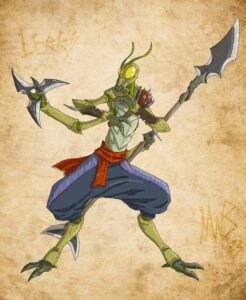 V’shekk – Mantis-like Krinari The V’shekk are the swift, deadly hunters of the Krinari, bearing the traditional mantis-like appearance with sleek, agile frames and razor-sharp forelimbs. They are renowned for their prowess in combat, moving with grace and precision unmatched among their kin. Their large, angular eyes give them exceptional vision across the sands, and they use natural camouflage to stalk their prey. The V’shekk serve as the Krinari’s scouts and elite fighters, often leading expeditions into the vast desert to protect their territories and acquire resources.
The V’Shekk THRI-KREEN TRAITSS
Kreen physiology gives it several natural advantages that compensate for not being able to utilize items commonlyworn by other races.
Ability Score Increase.
Your Dexterity score increases by2, and your Wisdom score increases by 1.
Age.
A thri-kreen is born from an egg and becomes fullymature at 6 years. They demonstrate no effect of aging untilthey reach the end of their life cycle around 30 years. Sensingtheir death, such thri-kreen go on a final hunt.
Alignment.
Most Thri‐kreen are chaotic, acting inwhatever fashion benefits the pack mentality, and this rarelyleads them to philosophies of good and evil.
Size.
A typical thri-kreen is 7 feet tall, 11 feet long, andweighs 450 pounds. Unlike other races, variation in heightand weight is nominal and a few inches or pounds at most.You occupy a 10 foot by 10 foot space and have 5 foot reach.Your size is Large.
Speed.
Your base walking speed is 40 feet.
Carapace.
Your chitinous plates provide a natural armorclass of 13 + Dexterity modifier. You cannot wear armor butyou may carry a shield.
Thri-kreen Physiology.
You only require 1 gallon of waterper week. You cannot swim. You cannot wear items fitted forhumanoids (boots, armor gloves/gauntlets, helmets/hats orrobes); however you can wear bracers, cloaks/capes, andrings.
Sleepless.
You require no sleep and are immune to
sleep
effects. You need only 4 hours of light activity to gain thebenefits of a long rest. You are not required to make saves fora Forced March.
Thri-kreen Weapon Training.
You are proficient with thegythka, chatkcha, and your claws and bite.
Claws.
Your claws can be used to make a single naturalattack for 1d4 + Strength modifier slashing damage. At 5thlevel, this increases to 2d4.
Bite.
Your bite can be used to make a natural attack for1d4 + Strength modifier piercing damage. At 5th level, youadd thri-kreen venom to your bite. A target must make aConstitution save or be poisoned for 1 minute; if failed by 5or more, the target is paralyzed for the duration. The targetrepeats the save at the beginning of its turn to end the effect.The DC is 8 + proficiency bonus + Constitution modifier.
Additional Arms.
You have two ancillary arms below yourmain ones. Each of these weaker arms can hold items but noteffectively wield weapons or shields. You may use your extraarms to stow or retrieve one item each turn without using anaction and may freely swap items between your arms withoutusing an action.
Leap.
At 3rd level, your legs have grown powerful enoughto jump 50 feet forward or 20 straight up, without a runningstart. You cannot jump backwards.
Naturally Psionic.
A Thri-kreen psion’s Psi Pointmaximum increases by 2 and by another 2 at 5th level. A non-psion Thri-kreen gains an additional Wild Talent at 1st leveland a third at 10th level.
Languages.
You can speak Thri-Kreen and Common. Thri-Kreen is a language composed of clicks and whirring,antennae movements, and pheromone emissions that non-kreen find too difficult to interpret and impossible toduplicate. When you speak other languages, you use a high-pitched voice.
Each Krinari subspecies serves a vital role, and together, they form a resilient and enigmatic society, thriving where few others can. Their bonds are strong, and their unique adaptations make them a force both feared and respected in the desert.
The Un’Thrall
A Thrall is an incredibly tough crossbreed of a human and dwarf (a half-dwarf). They retain the stature, agility, and mental flexibility of humankind, coupled with the physical resilience and endurance of their dwarven heritage –a rare combination of qualities that makes thralls more than a simple blend of the two races. They stand around 6 to 7 feet in height and have a point to their ears. Many of their facial features are that of a dwarf.
Because they are strong, tough, quick, and blessed with fantastic endurance, thralls are high prized as slaves. In fact, most muls are born into slavery, products of the slave pits —owners recognize the thralls’ assets as gladiators and laborers, and so order the births of as many muls as can be managed within the ranks of their slaves. Thralls are born sterile —they cannot perpetuate their kind.
Born as they are to lives of slave labor, with the taskmaster’s whip taking the place of parents and family, thralls are given to a gruff personality and violent reactions. Understandably, many never seek friends or companionship but live out their lives in servitude, driven by hatred and spite. Most, however, learn who to trust in the slave pits and who not to, gaining favor and reputation among the other slaves.
Many slaves have either escaped or otherwise won their freedom and now live independent lives all over Thaldor. Of these, a large percentage have bartered their combat prowess, making their way as soldiers or guards. A few others, given to more cerebral pursuits, have turned to priestly devotions or the mental disciplines of psionics.
Thralls are half-dwarves, a cross between a male Dwarf and female Human. Because of their large bone structures, the pregnancy is hard on both the mother and Mul, usually resulting in the child having to be cut from his/her dying mother’s body.
UN’THRALL TRAITS
The Un’Thrall is bred for physical attributes but can inherit a parent’s quick mind. A Thrall cannot be an arcane caster, having inherited their dwarven heritage.
Ability Score Increase.
Your Strength score increases by 2 and your Constitution and Wisdom by 1.
Age.
A Thrall ages like humans, tending to reach adulthood a year or two year earlier and given their lot in life rarely reach the age of 85.
Alignment.
Thralls tend towards neutrality with respect to good and evil, but run the gamut with respect to law or chaos. Many lawful Thralls adapt well to the indignities of slavery, playing the game for the comforts that they can win as valued slaves. A few ambitious lawful Thralls use the respect won from their fellow slaves to organize rebellions and strike out for freedom. Chaotic Thralls, on the other hand, push their luck and their value as slaves to the breaking point, defying authority, holding little fear for the lash.
Size.
A typical Thrall is 7 feet tall and weighs over 250pounds. Your size is Medium.
Speed.
Your base walking speed is 30 feet.
Relentless Endurance.
When you are reduced to 0 hitpoints but not killed outright, you can drop to 1 hit pointinstead. Once you use that trait, you can’t use it again untilyou finish a long rest.
Inexhaustible.
You have advantage on Forced March savesand all saves to resist non-magical exhaustion. If you spend 1 minute focusing yourself, you can remove one level of non-magical exhaustion. Once you use this trait, you can’t use it again until you finish a long rest.
Languages.
You can speak Common plus a language ofyour choice.
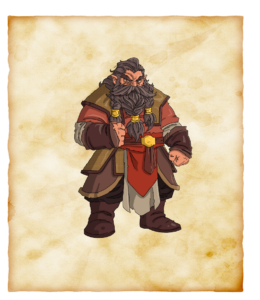 Knurl (Dwarf)
A dwarf’s chief love is toil. A dwarf is never happier than when there is a cause to work or fight for, something he can approach with stoic singlemindedness for weeks, months, years, or even decades at a time. Once a dwarf’s mind is committed to a certain task, he’ll only set it aside after a great deal of grumbling and coercion. The fulfillment he achieves upon completion of a lengthy, difficult task is what he strives for. Lives of hard work in the hot sun leave them with a rich tan and rugged, calloused hands and feet.
The task to which a dwarf is presently committed is referred to as his focus. A dwarf’s focus must be a feat requiring at least one week to complete. Shorter term goals cannot be considered a focus.
Actually, a dwarf’s commitment to his focus is based in his physiology—those who complete their lives before they complete their foci live out their afterlives as banshees in the wastes, haunting their unfinished works!
By nature, dwarves are nonmagical and never use arcane magic or spells. . An dwarf takes notice of other beings based upon his focus. If the other being is also actively committed to the dwarf’s focus, the dwarf will consider him a sensible and dependable companion. If, however, the other being is vehemently opposed to the dwarf’s focus, the two will be irrevocably at odds until one or the other is dead. There is very little room for compromise in the mind of a dwarf.
DWARF TRAITS
Dwarves are nonmagical by nature and tend to shun arcane casters. Dwarves leave villages at times to further a focus and to search for ancient dwarven ruins. They are highly prized as mercenaries because once contracted, their loyalty will never change.
Ability Score Increase.
Your Constitution score increases by 2, and you choose to increase your Strength or Wisdom by1.
Age.
Dwarves mature around age 35 and live up to 250years, though the dangers of Athas often claim them well before this time.
Alignment.
Dwarves tend lawful and good to neutral. Their devotion to an established hierarchy in villages means they tend to follow rules even to the point of ridicule.
Size.
A typical dwarf stands about 4 ½ to 5 feet tall and weighs 200 pounds. Your size is Medium.
Speed.
Your base walking speed is 25 feet. You are not slowed by wearing heavy armor.
Darkvision.
Despite living aboveground, your heritage allows you to see in dim light within 60 feet of you as if in bright light, and in darkness as if it were dim light. You can’t discern color in darkness, only shades of gray.
Dwarven Focus.
When making an ability check or saving throw directly related to your Focus, you are considered proficient.
Dwarven Resilience
. You have Advantage on poison and all magical saves and resistance to poison damage.
Tool Proficiency.
You gain proficiency with the artisan’s tool of your choice: smith’s tools, brewer’s supplies, or mason’s tools.
Dwarven Toughness.
Your hit point maximum increases by 1 and it increases by 1 every time you gain a level.
Languages.
You can speak Common and Dwarvish. Your character might be able to read Dwarvish with an appropriate background. Dwarves keep a long and proud oral history, and they have an old written language mostly used for writing history that they will never share to outsiders. Their native language is deep and throaty, full of guttural sounds and harsh exclamations that cause most non-dwarves to get raw throats if spoken for long.
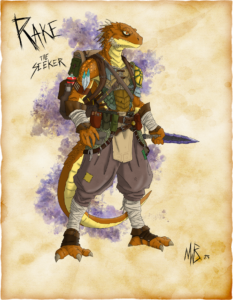 Ssurran (Lizardfolk)
Ssurrans are a race of reptilian humanoids, distantly related to silt runners, but much larger. Ssurrans range in size from 4 to 6 feet tall and weighing anywhere between 180 and 225 pounds.
Their thick leathery hide is found in all manner of earthen tones, and has seen them adapt well to the harsh desert climate and provides some manner of camouflage in the desert environment. Their heads feature a pronounced, toothy snout –-perpetually curved into a slight, sly smile-– and small, dark eyes. Their crocodilian appearance is completed by a thick, non-prehensile tail, between 2 and 3 feet in length, used for balance, posture, and communication.
A typical ssurran is clad in a loing cloth, bone jewelry, patchwork armor, assorted knickknacks, and battered trade goods, and armed with a bizarre assortment of weaponry from all across the Great Desert and Borderlands, usually stripped from past victims.
Ssurrans are a pragmatic people, concerned with the survival of themselves and their tribe more than anything. While they have a reputation about them as vicious wastelanders, there’s also a strange form of honor among some of them. They’re also a strangely devout people, praising the gods of the land and the sun highly.
SSURRAN TRAITS
Your ssurran character has the following traits:
Ability Score Increase.
Your Constitution score increasesby 2 and your Wisdom score increases by 1.
Age.
Ssurran reach maturity by 14 years and rarely livelonger than 60 years.
Size.
Ssurran are a little bulkier and taller than humans andtheir frill makes them appear taller. Your size is Medium.
Bite.
Your fanged maw is a naatural weapon, which youcan use to make unarmed strikes. If you hit with it, you dealpiercing damage equal to 1d6+your strength modifier.
Cunning Artisan.
As part of a short rest, you can harvestbone and hide from a slain beast, monstrosity, or plantcreature Small or larger to create one of the following items:a shield or buckler, a club, a javelin, or 1d4 darts or blowgunneedles. To use this trait, you need a blade and theappropriate artisan’s tools.
Hunter’s Lore.
You gain proficiency with two of thefollowing skills of choice: Animal Handling, Nature,Preception, Stealth, and Survival.
Natural Armor.
You have tough, scaly skin. When youaren’t wearing armor, your AC is 13+ your Dexterity modifier.A shield’s benefits apply as normal when you use your naturalarmor.
Tail Flick.
You can use a bonus action to to make an attackwith your tail as an unarmed strike. You can choose to do 1d4bludgeoning damage or you can choose to force the target tomake a strength saving throw or be tripped prone.
20